
The Role of Therapists Crying in Therapy


Taylor Rodriguez, B.S. & Jenelle Slavin-Mulford, Ph.D.
January 14, 2018

An important aspect of psychotherapy is the therapist’s reactions to his or her client during session (Kahn & Fromm, 2001; Summers & Barber, 2010). One type of emotional expression that has garnered interest throughout the psychological literature is the phenomenon of therapists crying with their patients (McWilliams, 1994; Alden, 2001; Summers & Barber, 2010; Guntrip, 1975/1986). However, there is limited empirical research on therapists crying in therapy (TCIT).
Blume-Marcovici, Stolberg, and Khademi (2013) sought to examine TCIT and help therapists explore, predict, and prepare for their own likelihood of TCIT. In this study, crying was defined following the Adult Crying Inventory, “tears in one’s eyes due to emotional reasons” (Vingerhoets & Cornelius, 2001).
Using a sample of 684 psychologists, postdoctoral psychology fellows, and psychology graduate students, they found the following:
- Most clinicians reported having cried in therapy.
- Most clinicians did not report negative consequences of their tears.
- Almost half of clinicians reported that crying in therapy improved the therapeutic relationship.
- Personality traits and empathy do not seem to be highly influential in TCIT.
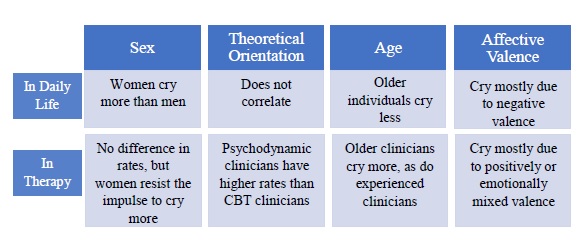
- Clinicians who reported more crying in daily life also tended to report more TCIT. However, there were differences between the motivations and trends for crying in daily life and in therapy. These are outlined below.
Conclusions
The results of the research suggest that:
- Therapists do cry in therapy.
- The variables used to predict tears in daily life are different than those that predict tears in therapy.
- Factors related to both the therapist as well as the therapy process seem to be influential for TCIT rates.
- TCIT can be a moment of positive emotional connection even within painful negative affect.