
Finding the Link Between Expectations and Outcomes in Therapy


Austin Drew Pierson, M.S. & Jenelle Slavin-Mulford, Ph.D.
April 23, 2017

Premature termination is a pervasive problem in psychotherapy (Garfield, 1994) and campus mental health services are especially vulnerable to increased rates of this problem. Although client expectations have consistently been associated with premature termination (e.g., Callahan et al., 2009; Dew & Bickman, 2005; Reis & Brown, 2006), the role of therapist expectations is still not well understood.
Recently, in a sample of trainee psychotherapists in a university training clinic, Connor and Callahan (2015) explored
- whether therapists’ general expectations for therapy outcomes are in line with outcomes reported in the literature
- how therapists’ expectations regarding the general duration and effectiveness of psychotherapy is related to their clients’ outcomes
- whether therapist experience moderates the relationship in number 2
In this exploration, they first asked therapists several questions related to their perceptions on typical therapy outcomes such as what percentage of clients they thought would show clinically significant change (CSC) and/or terminate after given session numbers. These types of predictions were then compared to outcomes reported in the literature and to specific outcomes of these therapists’ clients. In measuring client outcomes, they used The Outcome Questionnaire 45.2 (OQ 45.2) to determine which clients experienced CSC or terminated prematurely (i.e., ending therapy prior to achieving CSC).
Connor and Callahan (2015) found that
- Therapists were unable to accurately predict client improvement or premature termination, instead predicting significantly more improvement than is represented in the literature.
- Therapists’ expectations of therapy outcomes were positively associated with CSC in their clients. In fact, psychotherapist expectations were found to explain 7.3% of the variance in whether or not clients experienced CSC. Therapist expectations did not differ by level of experience.
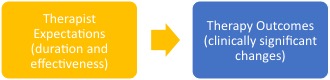
The results of this article suggest that:
- what the therapist believes about therapy matters
- therapist expectations positively predict therapy outcomes
- therapists often do not accurately assess which clients terminate prematurely and should therefore utilize measures of clinically significant change
- therapists and clients may overestimate the effectiveness of therapy