
From Research to Practice: Meet the Author Event Promotes International Dialogue in Psychotherapy

Di An, A & 3 others
March 17, 2026

On January 24, 2026, the Society for the Advancement of Psychotherapy (SAP) China Chapter successfully hosted its member event Meet the Author.
The event was jointly organized by SAP International Domain, and the SAP China Membership Engagement Committee of International Domain, and hosted by the Hubei Oriental Insight Mental Health Institute (OI). The event aimed to foster direct dialogue between authors of the journal Psychotherapy and clinical practitioners, promoting meaningful exchanges between international research and clinical practice.
The event featured two keynote sessions, focusing on the themes of change theory in Interpersonal Reconstructive Therapy and synchrony in psychotherapy. More than 40 Chinese SAP members participated in real-time discussions via Zoom, while over 1,400 viewers watched the event via simultaneous livestream. The event received highly positive feedback from both members and the broader audience.
Opening Remarks: Building a Platform for Cross-Cultural Dialogue
The event officially opened at 8:50 a.m. (Beijing Time), with Luyao Ma, Executive Officer of the China Membership Engagement Committee, serving as host. Dr. Joshua Swift, President of SAP, and Dr. Xu Li, Board Representative of the SAP International Domain, were invited to deliver the opening addresses.
Dr. Swift expressed his appreciation to all members and participants. He emphasized that the Meet the Author series provides an important platform for researchers and clinicians to engage in cross-cultural dialogue and supports the translation of research into clinical competence—one of the key goals of the collaboration between SAP and OI.
Dr. Li highlighted that the event created a valuable space for direct dialogue among authors, readers, and practitioners, helping research findings move into real-world clinical practice. He underscored the importance of cross-cultural academic exchange for the development of psychotherapy in China and for amplifying Chinese professionals’ voices in international discourse.
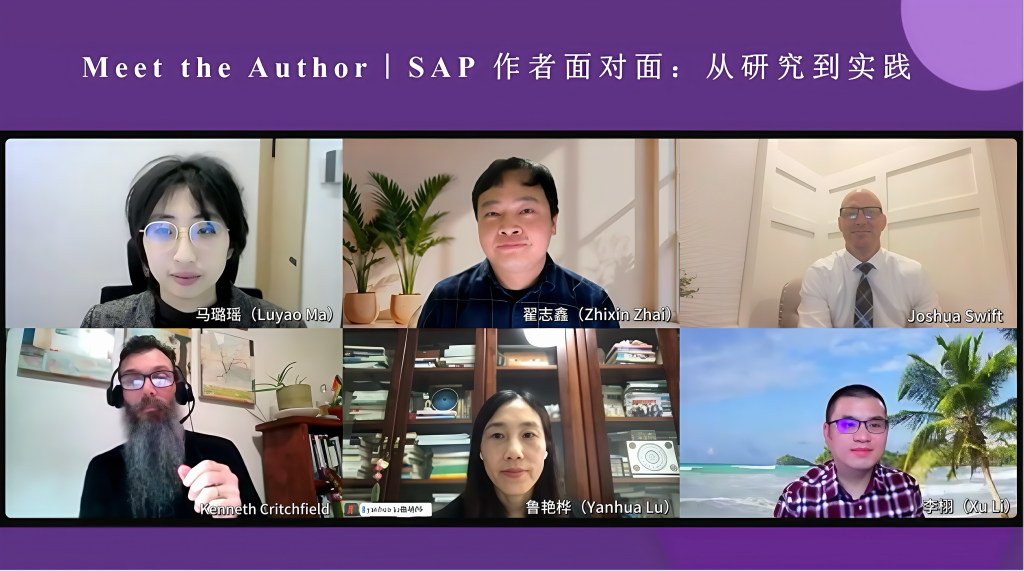
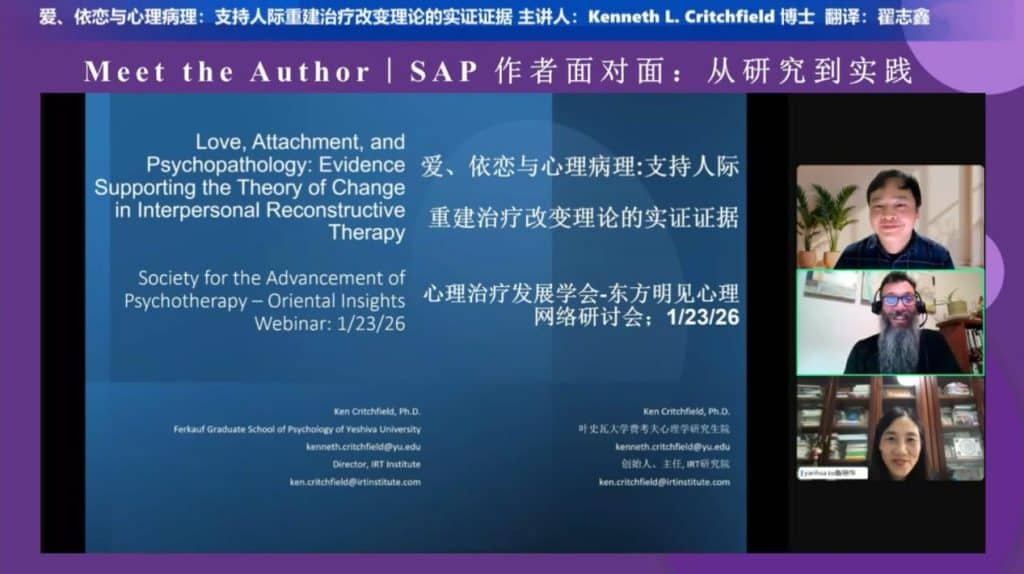
Session I: Love, Attachment, and Psychopathology: Evidence Supporting the Theory of Change in Interpersonal Reconstructive Therapy
The first session was presented by Dr. Kenneth L. Critchfield, Associate Professor and Director of the Clinical Psychology Program at the Ferkauf Graduate School of Psychology, Yeshiva University. The session was moderated by Dr. Yanhua Lu, Vice Chair of the China Member Engagement Committee, with Zhixin Zhai, a doctoral student in Counseling Psychology at the University of Kansas, serving as the interpreter.
Dr. Critchfield introduced the core theoretical framework of IRT, with a particular focus on the “gift of love hypothesis” (GOLs). Drawing on empirical research, he discussed key mechanisms underlying changes in relational patterns during psychotherapy and their clinical implications. During the Q&A session, Dr. Critchfield addressed participants’ clinical questions and shared insights from his extensive clinical experience. Dr. Lu concluded the session with a summary.
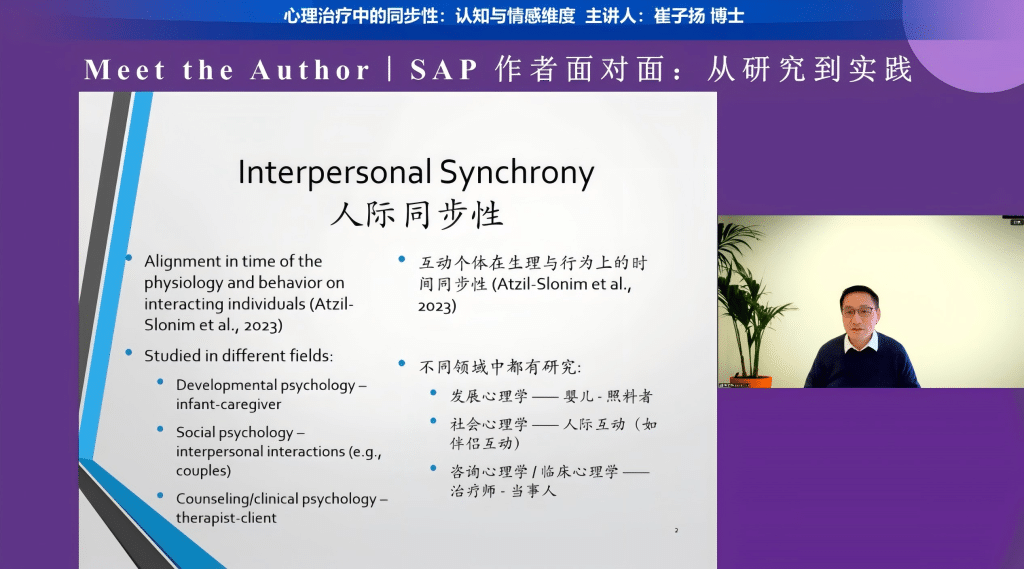
Session II: Becoming in Sync in Psychotherapy: Cognitive and Affective Dimensions
The second session was delivered by Dr. Harold Chui, Associate Professor in the Department of Educational Psychology at The Chinese University of Hong Kong. The session was also moderated by Dr. Yanhua Lu.
Based on two empirical studies, Dr. Chui systematically examined the role of synchrony in psychotherapy outcomes from both cognitive and affective perspectives. He also discussed methodological pathways for studying synchrony in real-world clinical settings and offered practical implications for therapist training and clinical practice. Following the presentation, Dr. Chui engaged in an in-depth discussion with participants on the clinical identification and application of synchrony. Dr. Lu provided a concluding summary.
Event Impact
Through two thematic presentations, the event provided Chinese SAP members and Chinese audiences with a valuable opportunity to engage directly with cutting-edge international research. By offering in-depth exploration of change theory in Interpersonal Reconstructive Therapy and professional insights into the mechanisms of synchrony in psychotherapy, the sessions not only broadened the academic perspectives of clinical practitioners, but also fostered cross-cultural academic exchange and experience sharing, strengthened the understanding and application of research findings in clinical practice, and further advanced knowledge dissemination and practical innovation in the field of clinical psychology in China.