
Building Bridges: The SAP China Conference Successfully Conducted



Society for the Advancement of Psychotherapy & 3 others
December 13, 2024

From November 6 to 9, 2024, the Society for the Advancement of Psychotherapy (SAP) China Conference, titled Counseling and Psychotherapy in Practice: New Perspectives on Therapist Skills and Development (心理咨询与治疗实践:治疗师技能与发展的新视野), was successfully conducted.
The conference was organized by the SAP International Domain and its Chinese Member Engagement Committee, with Hubei Oriental Insight Mental Health Institute (OI) serving as the local host. The purpose of the conference was to establish a global, high-level platform for the exchange of cutting-edge research and clinical practices in psychotherapy, promoting international communication between researchers and practitioners, and enhancing SAP’s influence in China, where the interest in and need for counseling and psychotherapy are soaring.
The event brought together esteemed experts, scholars, researchers, and practitioners from SAP and both the U.S. and China. The program featured three keynote presentations, three corresponding roundtable discussions, and a workshop, focusing on four critical themes: therapist skills, therapist selection and training, psychotherapy integration, and deliberate practice.
The conference attracted over 16,000 cumulative viewers and garnered overwhelmingly positive feedback. Participants praised the event for providing valuable insights and practical guidance, making it a true academic and professional feast.
Opening Ceremony
The SAP China Conference officially commenced on the evening of November 6. Dr. Changming Duan moderated the opening ceremony. Dr. Stewart Cooper, Dr. Guangrong Jiang and Dr. Xu Li were invited to deliver opening remarks.
In his address, Dr. Stewart Cooper shared his vision for 2025, emphasizing the importance of supporting understanding of cutting-edge practices in the field of psychotherapy, fostering global exchange and collaboration, and encouraging participants to actively contribute to the advancement of psychotherapy science, practice, education, and application.
Dr. Guangrong Jiang reflected on the longstanding collaboration between OI and SAP, describing the two organizations as “like-minded old friends.” He expressed hope that this conference, which bridges cutting-edge research and practice, would provide professionals with truly “new perspectives” for their development.
Dr. Xu Li emphasized the importance of communication, expressing hope that the expertise of Chinese professionals would gain greater recognition globally. He likened the conference to a “bridge”, envisioning it as not only a connection between SAP and Chinese researchers and practitioners but also a link between research and practice.
At the end of the opening ceremony, Dr. Changming Duan extended heartfelt gratitude to the distinguished guests, conference organizers, and all attendees for their contributions and support. Then she officially declared the conference open.
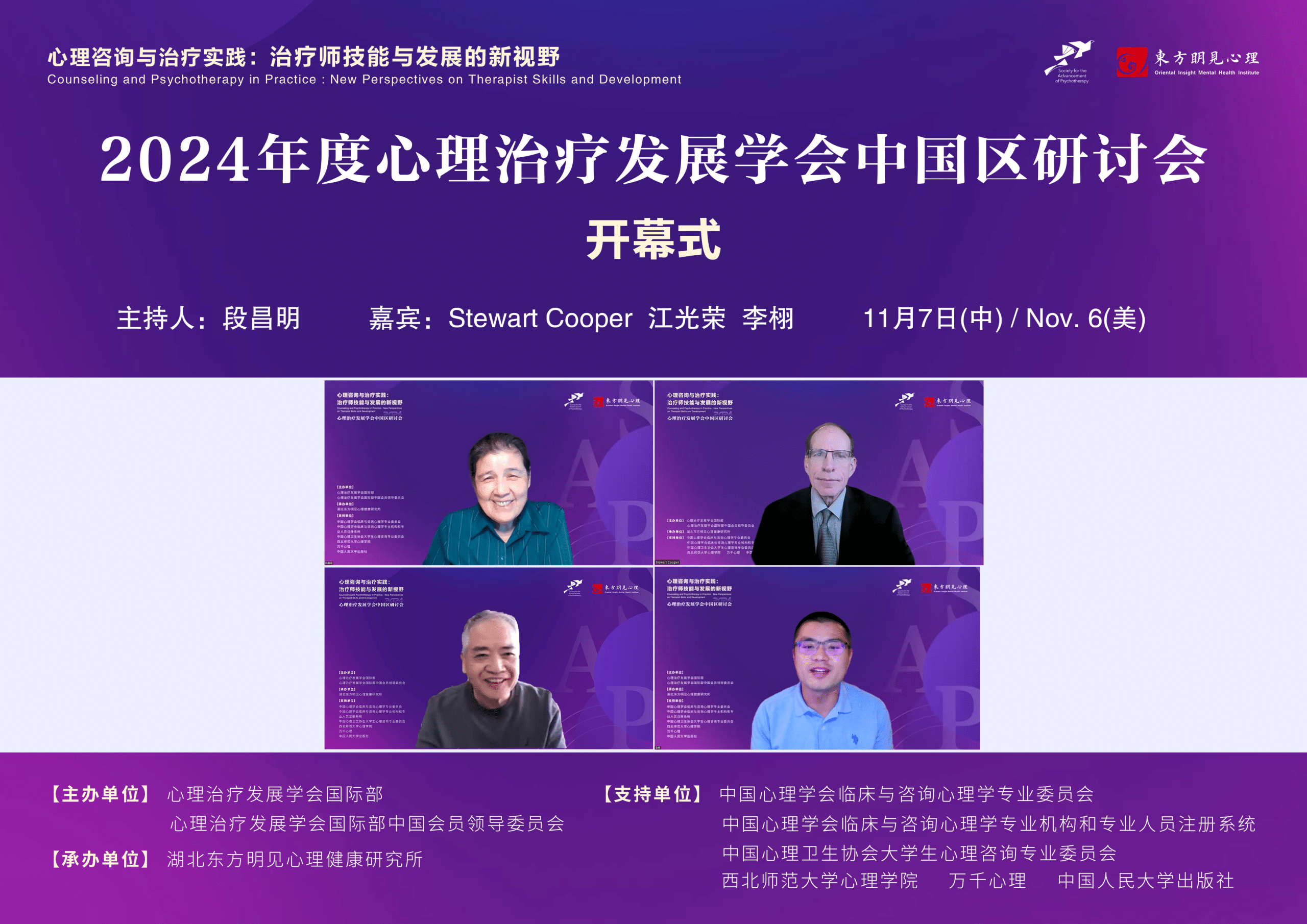
Changming Duan (段昌明), PhD. International Committee Co-Chair, Society for the Advancement of Psychotherapy.
Stewart Cooper, PhD. President-Elect, Society for the Advancement of Psychotherapy.
Gruangrong Jiang (江光荣), PhD. Founder, Hubei Oriental Insight Mental Health Institute.
Xu Li (李栩), PhD. International Domain Representative, Society for the Advancement of Psychotherapy.
Focus on Therapist Skills
Following the opening ceremony, the conference began with a keynote address by Dr. Clara Hill, titled Therapist Skills: Do They Matter? This segment was moderated by Dr. Xu Zhu and interpreted by Dr. Yujia Lei.
In her presentation, Dr. Clara Hill provided a historical overview of therapist skills and introduced current Hill Training Model. She organized her presentation around several key research questions: Is helping skills training effective for novice (undergraduate) trainees? If so, what are the effective components of training? Can we predict who will benefit from training? What do we know about the effectiveness about the various skills?
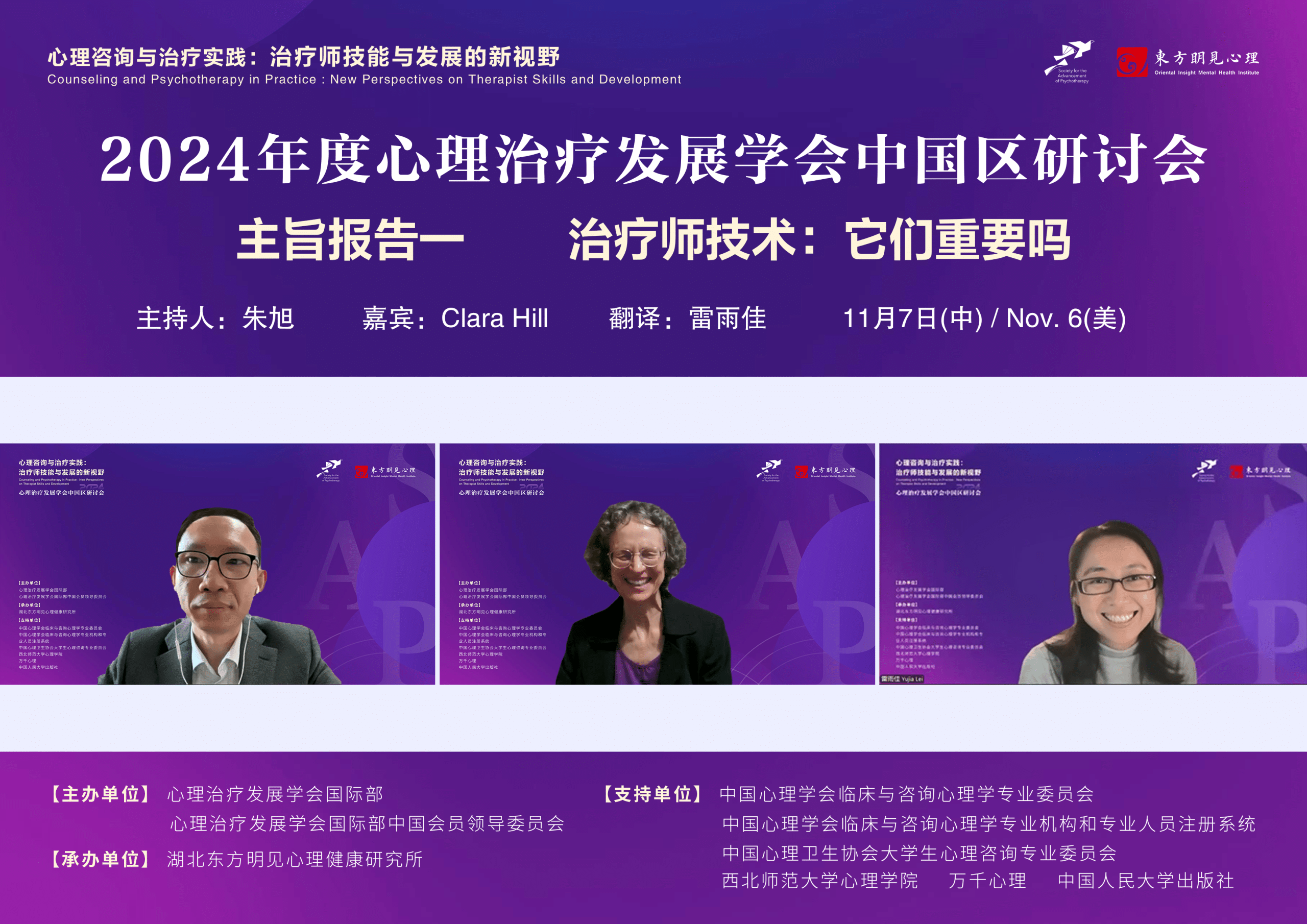
Clara Hill, PhD. Professor (Retired), Department of Psychology, University of Maryland.
Xu Zhu (朱旭), PhD. Associate Professor, School of Psychology, Central China Normal University.
Yujia Lei (雷雨佳), PhD. Psychologist and Adjunct Professor, Center for Counseling & Psychological Services, Washington University in St. Louis.
Following the keynote, Dr. Xu Zhu moderated a roundtable discussion titled Therapist Skills: Perspectives on Research and Practice. Panelists included Xiaoyan Zhong, Chunxiao Zhao, Jingru Chen and Xiao Fu.
The roundtable explored the interplay between research and practice from dual perspectives. Panelists shared insights into how research informs practice and how practitioners apply research findings in their practice. The discussion provided new perspectives and practical takeaways for both researchers and clinicians, trying to bridge the gap between empirical study and real-world application.
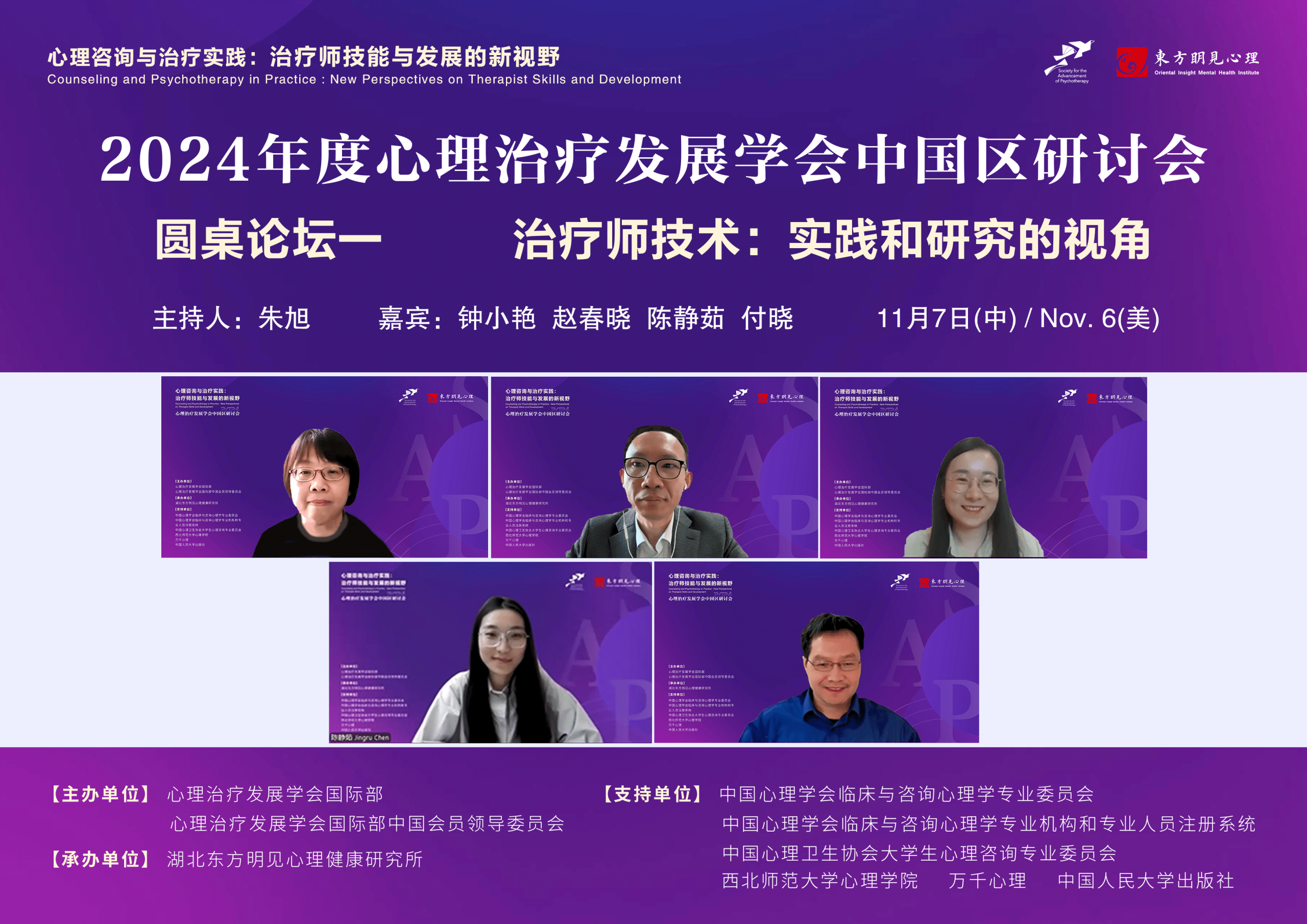
Xu Zhu (朱旭), PhD. Associate Professor, School of Psychology, Central China Normal University.
Xiaoyan Zhong (钟小艳), MS. Full-Time Counselor, Wuhan Qifa Psychology Studio.
Chunxiao Zhao (赵春晓), PhD. Director of the “College Pi” Project, Hubei Oriental Insight Mental Health Institute.
Jingru Chen (陈静茹), PhD. Psychologist, Yale Health Center, Yale University.
Xiao Fu (付晓), MS. Chinese Member, Society for the Advancement of Psychotherapy.
Focus on Therapist Selection and Training
On the evening of November 7, Dr. Xu Li delivered a keynote address titled Identifying and Training Effective Therapists: Insights from Research in a Chinese Master’s Training Program.Dr. Feihan Li served as moderator.
In his presentation, Dr. Xu Li explored the phenomenon of therapist effects in psychotherapy and discussed related research. He outlined factors that are and are not predictive of therapist effects and presented studies conducted within master’s-level therapist training programs in China. He also offered valuable implications for clinical practice and training in the Chinese cultural context.
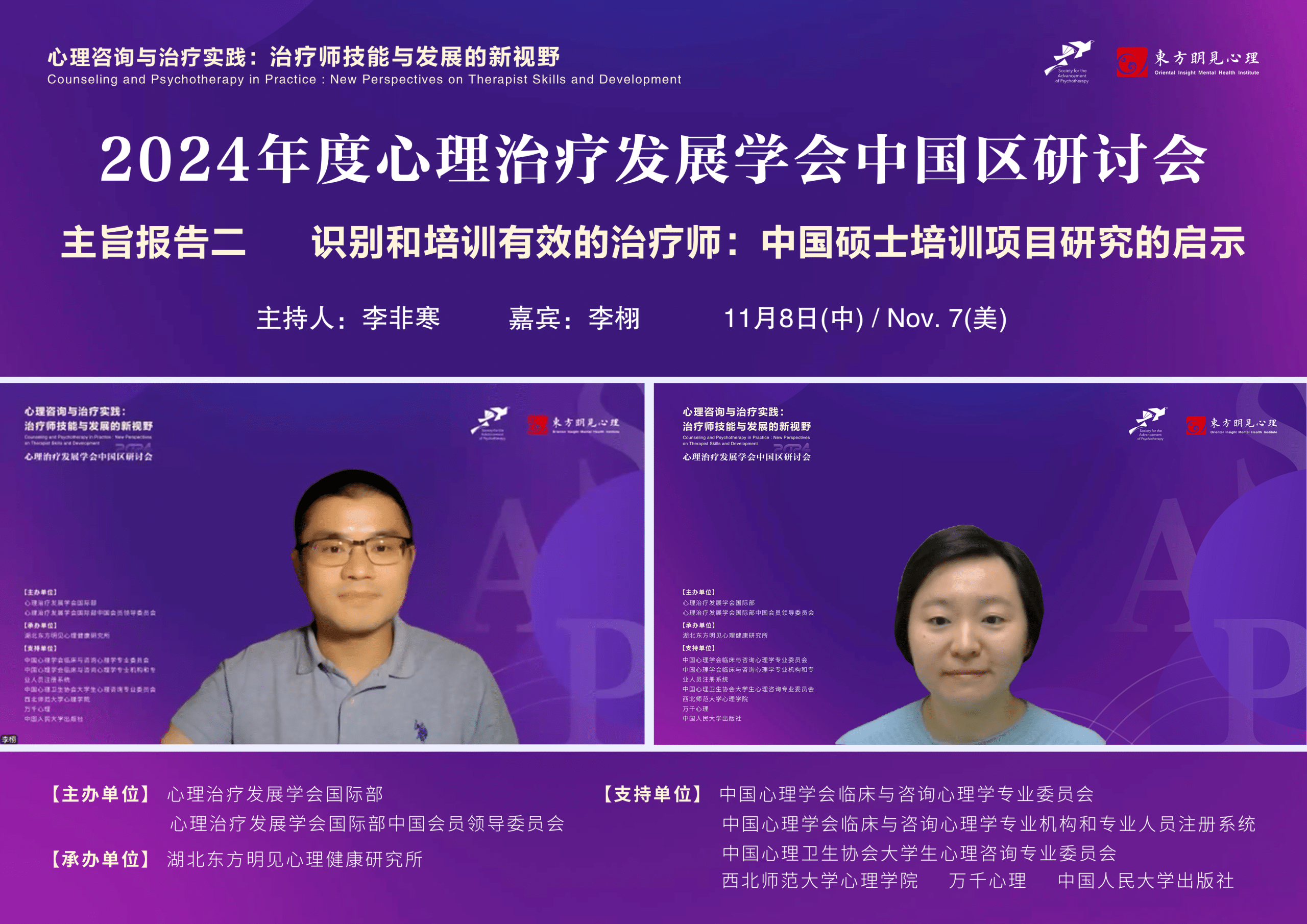
Xu Li (李栩), PhD. Associate Professor, Department of Educational Psychology, University of Illinois, Urbana-Champaign.
Feihan Li (李非寒), PhD. Lecturer, Faculty of Psychology, Beijing Normal University.
Following the keynote, Dr. Feihan Li moderated a roundtable discussion titled Counselor Selection and Training. Panelists included Jianping Wang, Jun Liu, Dongmei Wang and Danyang Li.
The roundtable focused on the systemic nature of counselor selection and training, emphasizing that these processes involve multiple dimensions, including professional knowledge, skills training, ethical awareness, personal growth, and lifelong learning. The engaging discussion inspired attendees, sparking thoughtful reflections on best practices for developing effective professionals.
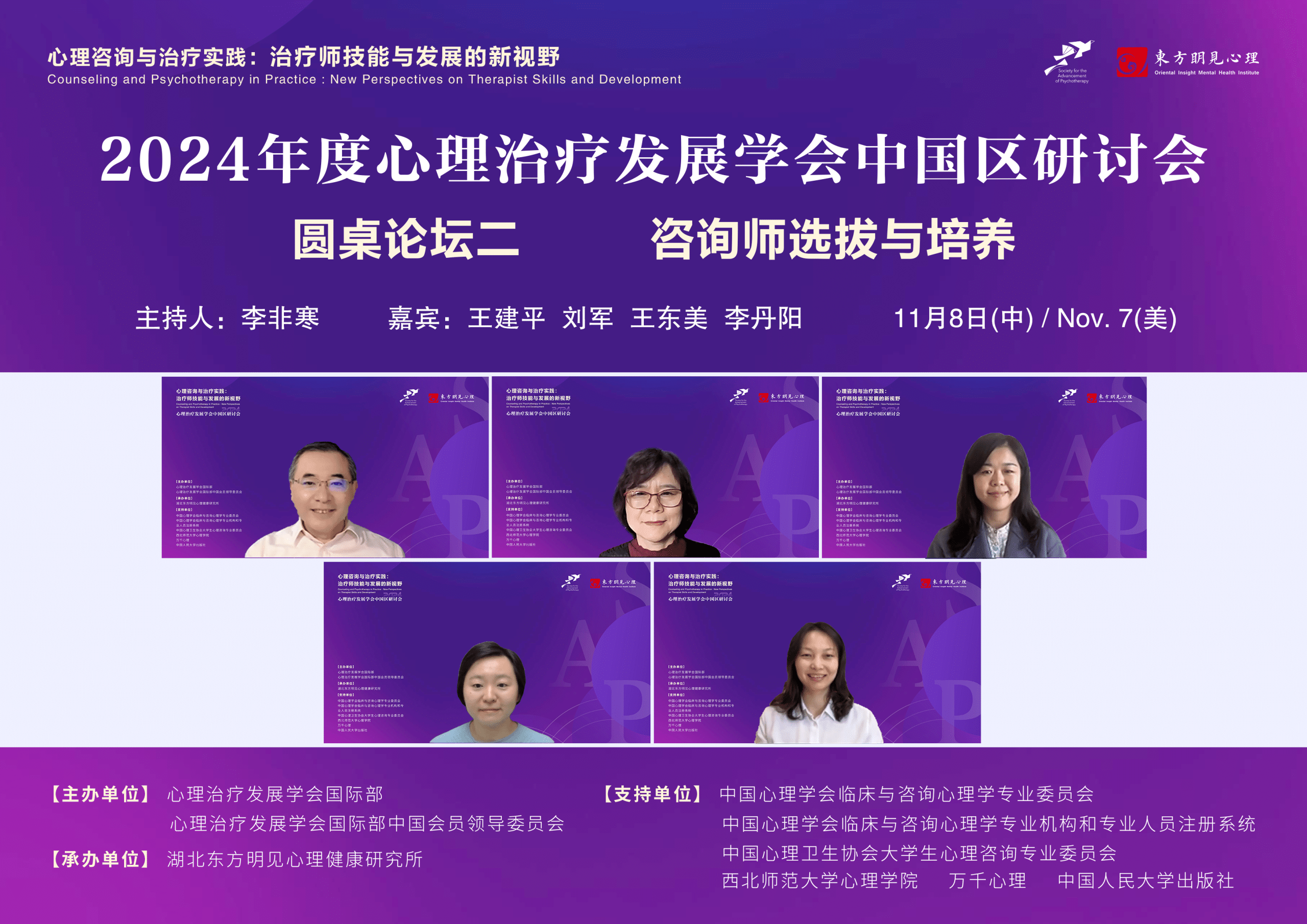
Feihan Li (李非寒), PhD. Lecturer, Faculty of Psychology, Beijing Normal University.
Jianping Wang (王建平), PhD. Professor, Faculty of Psychology, Beijing Normal University.
Jun Liu (刘军), Psychiatrist. Member, Clinical Psychology Registration Work Committee, Chinese Psychological Society.
Dongmei Wang (王东美), PhD. Assistant Professor, Department of Psychology, Nanjing University.
Danyang Li (李丹阳), PhD. R & D Director, Research & Development Center, Hubei Oriental Insight Mental Health Institute.
Focus on Psychotherapy Integration
On the evening of November 8, Dr. Gregg Henriques delivered a keynote address titled The Common Core: A New Paradigm for Psychotherapy. This segment was moderated by Dr. Changming Duan.
Dr. Gregg Henriques briefly reviewed the psychotherapy integration movement, and then he described the “common core” of psychotherapy. He introduced the Contextual-Process Model for common factors and the UTOK (Unified Theory of Knowledge) metatheory for the science and practice of psychology. He noted that the common core is formed by the bridge between the Contextual Model and UTOK.
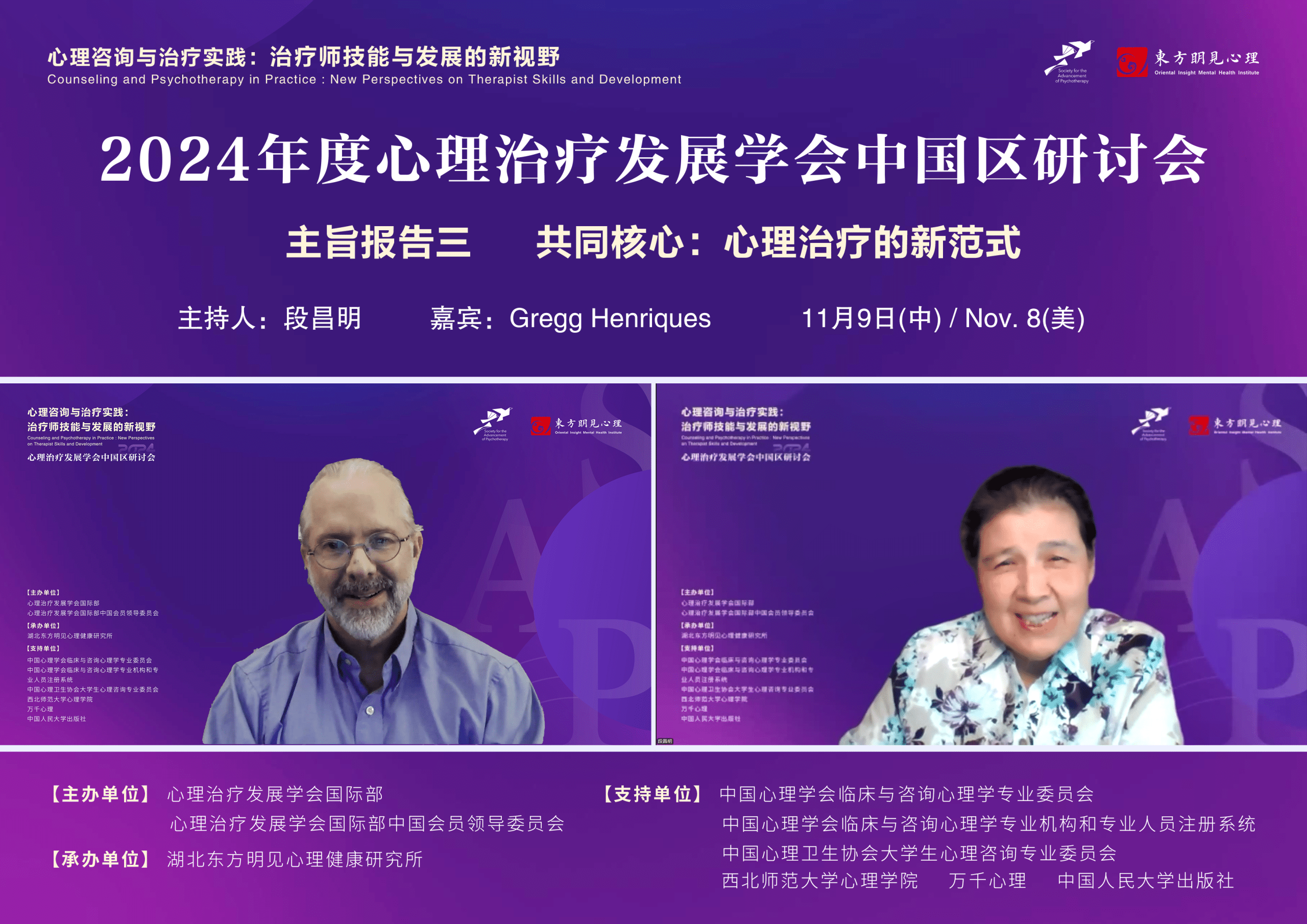
Gregg Henriques, PhD. Professor, Department of Graduate Psychology, James Madison University.
Changming Duan (段昌明), PhD. Professor, Department of Educational Psychology, The University of Kansas.
Following the keynote, Dr. Changming Duan moderated a roundtable discussion titled From “Common Factors” to the “Common Core”: Integrative Perspectives in Counseling Psychology. Panelists included Dong Xie, Jing Wang, Yupeng Yan and Linyu You.
The discussion continued and expanded on the theme of the keynote. Panelists addressed critical topics such as theoretical integration, cultural adaptability, the translation of theory into practice, and professional development. Panelists shared insights that not only enriched attendees’ understanding of psychotherapy integration but also provided forward-looking guidance for the field’s continued evolution.
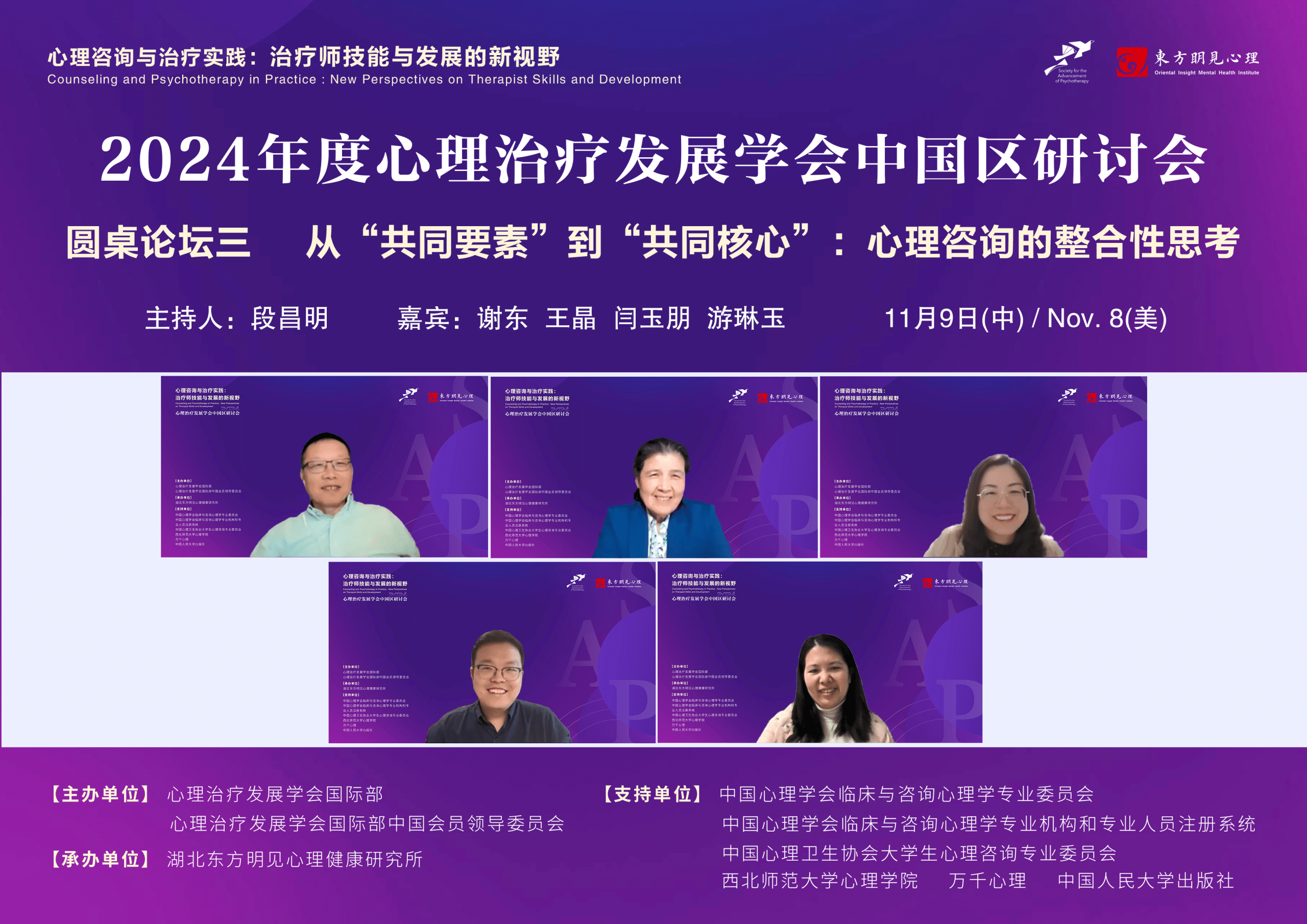
Changming Duan (段昌明), PhD. Professor, Department of Educational Psychology, The University of Kansas.
Dong Xie (谢东), PhD. Associate Professor, Department of Psychology and Behavioral Sciences, Louisiana Tech University.
Jing Wang (王晶), Psychiatrist. Mental Health Research Center, Tongji Medical College, Huazhong University of Science and Technology.
Yupeng Yan (闫玉朋), PhD. Director, Research & Development Center, Hubei Oriental Insight Mental Health Institute.
Linyu You (游琳玉), PhD. Counselor, Mental Health Center, China Foreign Affairs University.
Deliberate Practice Workshop
On the evening of November 9, Dr. Hanna Levenson conducted a workshop titled Deliberate Practice in Psychotherapy Training. This segment was moderated and interpreted by Dr. Robin Lee.
Dr. Hanna Levenson introduced the principles of deliberate practice, how deliberate practice can be applied in learning psychotherapy, and deliberate practice in psychodynamic training. During the second half of the workshop, she conducted a live demonstration, inviting attendees to experience deliberate practice for the skill of “making process comments” in psychodynamic therapy. Finally, she also outlined how therapists can set up a personalized deliberate practice routine for themselves and the empirical findings related to deliberate practice.
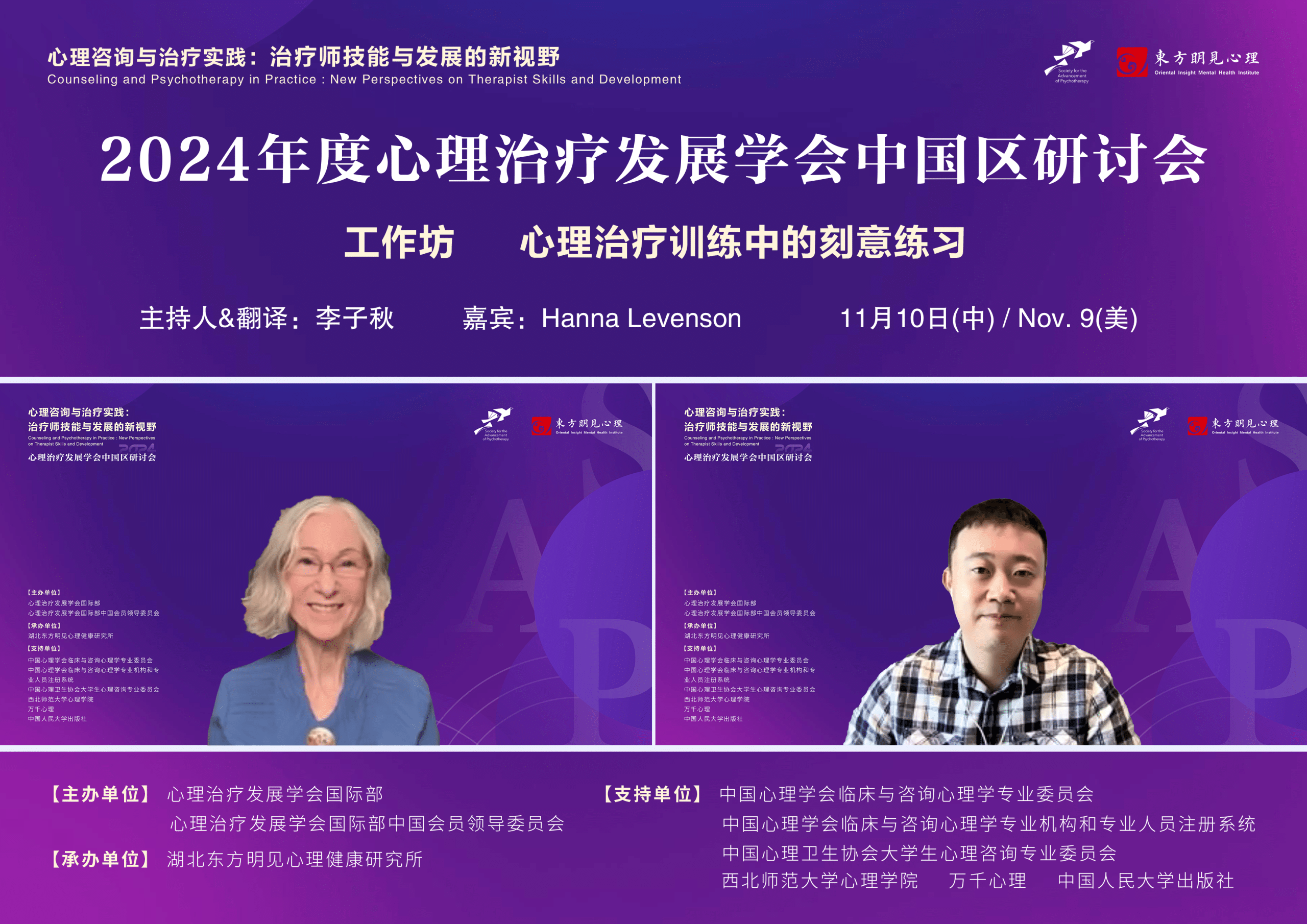
Hanna Levenson, PhD. Professor Emerita, Wright Institute, Berkeley.
Robin Lee (李子秋), PhD. External Lecturer and Supervisor, Faculty of Psychology, Beijing Normal University.
Closing Ceremony
Following the workshop, the conference concluded with a closing ceremony. Luyao Ma moderated the closing ceremony. Dr. Gujing Li delivered the closing remarks. In her speech, Dr. Gujing Li summarized the conference’s achievements over the four days, extending heartfelt thanks to all the distinguished guests, organizers, and attendees who contributed to the event’s success. She also encouraged more Chinese professionals to join SAP, fostering collective growth and advancing the field of psychotherapy.
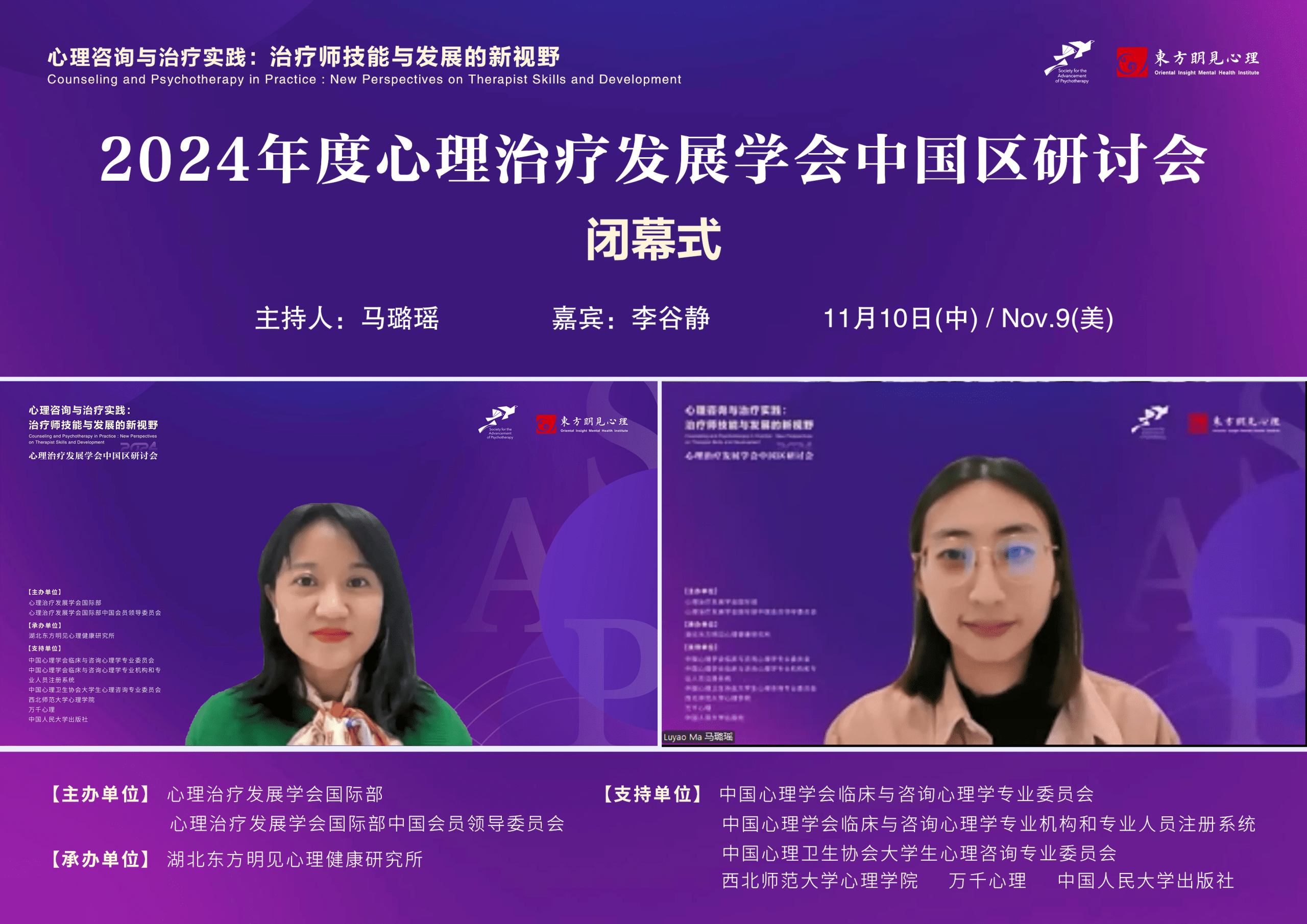
Gujing Li (李谷静), PhD. Chair, Chinese Member Engagement Committee, International Domain, SAP.
Luyao Ma (马璐瑶), MS. Executive Officer, Chinese Member Engagement Committee, International Domain, SAP.
Impact and Reach
The SAP China Conference received an overwhelming response, attracting widespread participation from researchers and practitioners across China. The conference reached over 16,000 cumulative viewers and garnered more than 25,000 cumulative views. Throughout the conference, nearly 1,500 live comments were submitted, including engaging questions, interactions, and positive feedback.
More than 1,700 attendees joined WeChat groups, reflecting strong interest in the conference and SAP. Notably, more than 140 individuals applied for SAP membership for 2025. These impressive figures highlight the conference’s exceptional quality and its significant contribution to enhancing SAP’s visibility and influence in China.
While the event has come to a close, its high-level discussions and professional insights are expected to continue inspiring and benefiting practitioners in the field.
Appendix: Conference Agenda
| Time (EST) | Title | Speaker | Moderator | Format | |
| Nov. 6 | 7:45-8:00 pm | Opening Ceremony | Stewart Cooper Guangrong Jiang Xu Li | Changming Duan | / |
| 8:00-9:30 pm | Therapist Skills: Do They Matter? | Clara Hill (Interpreter: Yujia Lei) | Xu Zhu | Keynote Address | |
| 9:30-11:00 pm | Therapist Skills: Perspectives on Research and Practice | Xiaoyan Zhong Chunxiao Zhao Jingru Chen Xiao Fu | Xu Zhu | Roundtable Discussion | |
| Nov. 7 | 8:00-9:30 pm | Identifying and Training Effective Therapists: Insights from Research in a Chinese Master’s Training Program | Xu Li | Feihan Li | Keynote Address |
| 9:30-11:00 pm | Counselor Selection and Training | Jianping Wang Jun Liu Dongmei Wang Danyang Li | Feihan Li | Roundtable Discussion | |
| Nov. 8 | 8:00-9:30 pm | The Common Core: A New Paradigm for Psychotherapy | Gregg Henriques | Changming Duan | Keynote Address (Pre-record) |
| 9:30-11:00 pm | From “Common Factors” to the “Common Core”: Integrative Perspectives in Counseling Psychology. | Dong Xie Jing Wang Yupeng Yan Linyu You | Changming Duan | Roundtable Discussion | |
| Nov. 9 | 8:00-11:00 pm | Deliberate Practice in Psychotherapy Training | Hanna Levenson (Interpreter: Robin Lee) | Robin Lee | Workshop |
| 11:00-11:10 pm | Closing Ceremony | Gujing Li | Luyao Ma | / | |