
Art Therapy with Ukrainian Refugees: A Pilot Program
Katerina Scott, BA & Elizabeth Nutt Williams, Ph.D.
September 25, 2025
In recent years, the number of worldwide refugees has skyrocketed. The United Nations High Commissioner for Refugees (UNHCR, 2025) reported there are over 43 million refugees—more than double what it was just 10 years ago—and 8 million asylum seekers internationally. Displaced people need support in variety of ways ranging from physical security to psychological treatment. While the experiences of refugees are unique and require individualized supports, many refugees endure mental health conditions at a higher percentage than the general population (World Health Organization [WHO], 2025). As such, it is crucial to make effective mental health support available to this vulnerable group. Because therapeutic intervention for refugees occurs in a country that this not their home country, cultural humility (Hook et al., 2017) and culturally informed therapeutic practices are essential for making mental health treatment accessible to this group. This approach can protect refugee populations from the risk of further isolation and harm caused by improper and inadequate treatment practices for this vulnerable population (Davis et al., 2018). Art therapy is one option that shows promise with refugees, given its emphasis on nonverbal expression, which may help those with difficulty talking about their experiences and ease the role of language barriers.
Examining the merger of culturally informed treatment with art therapy as an approach to helping refugee populations is important, but current research on such treatments with refugees is extremely limited, particularly when considering the needs of adult refugees (as opposed to child refugees). What empirical studies do exist, however, conclude that art therapy may be helpful with adult refugee populations (Scott & Williams, 2024). As one example of treatment effectiveness, Hanania (2020) found positive results in a pilot program with refugees from the Levant region of the Eastern Mediterranean that incorporated a culturally significant form of embroidery into group art therapy. The use of culturally significant materials in art therapy coupled with a community emphasis in a population often faced with cultural isolation could be a promising avenue of research and treatment.
Considering the need for adequate systems of mental health support for refugees, the potential of group art therapy, the importance of culturally informed care, the promising results of the Hanania (2020) study, and the lack of current research in this area, the authors conducted a pilot, exploratory, mixed-methods study of a group therapy program with Ukrainian refugees using culturally significant materials. These materials included Ukrainian symbols, such as the national flag, and collage materials significant in Ukrainian culture (i.e., images of Ukrainian cultural symbols and landscapes). The aim of the five-week program was to bring relief to the participants and to facilitate their connections to their communities and home cultures.
The Study
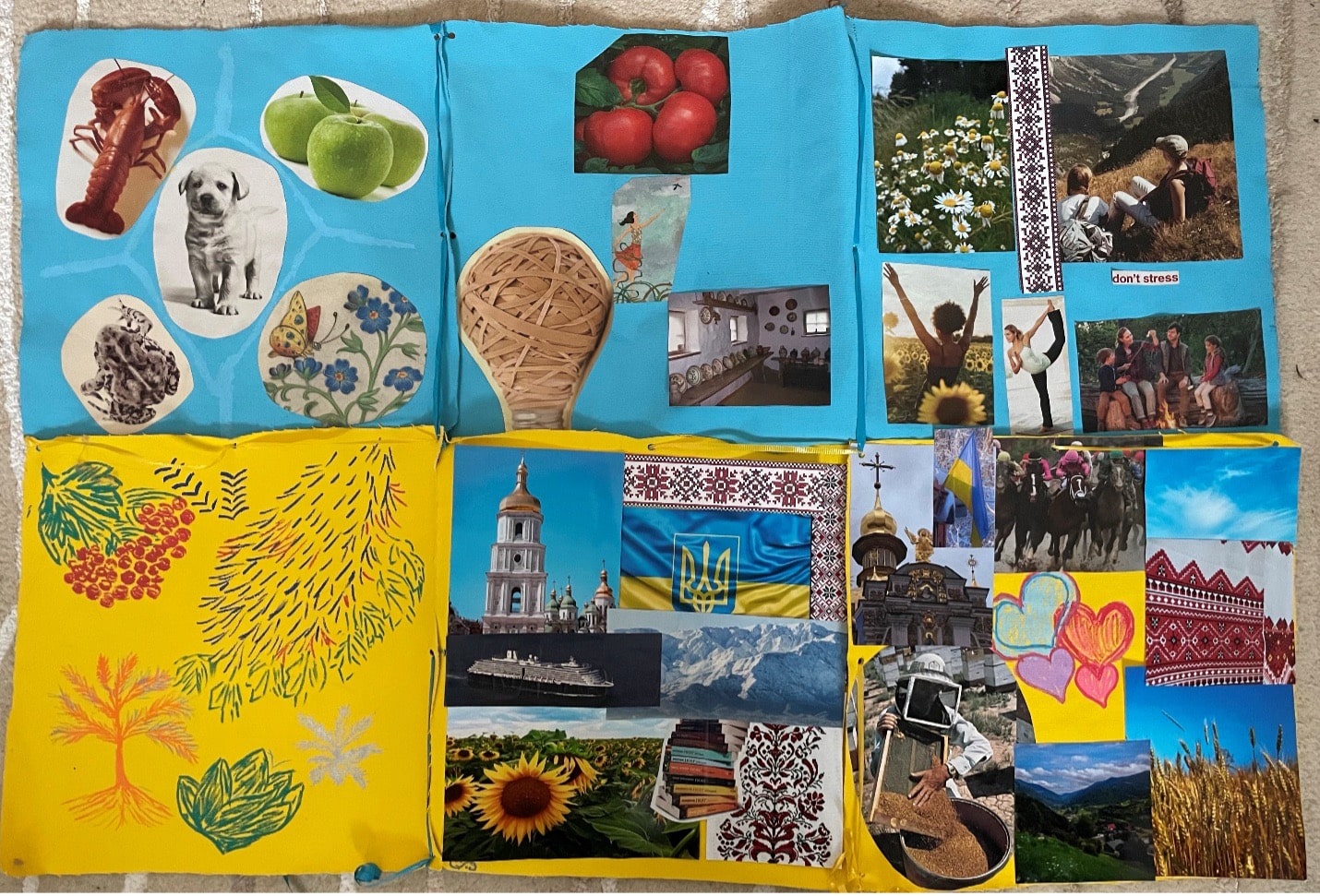
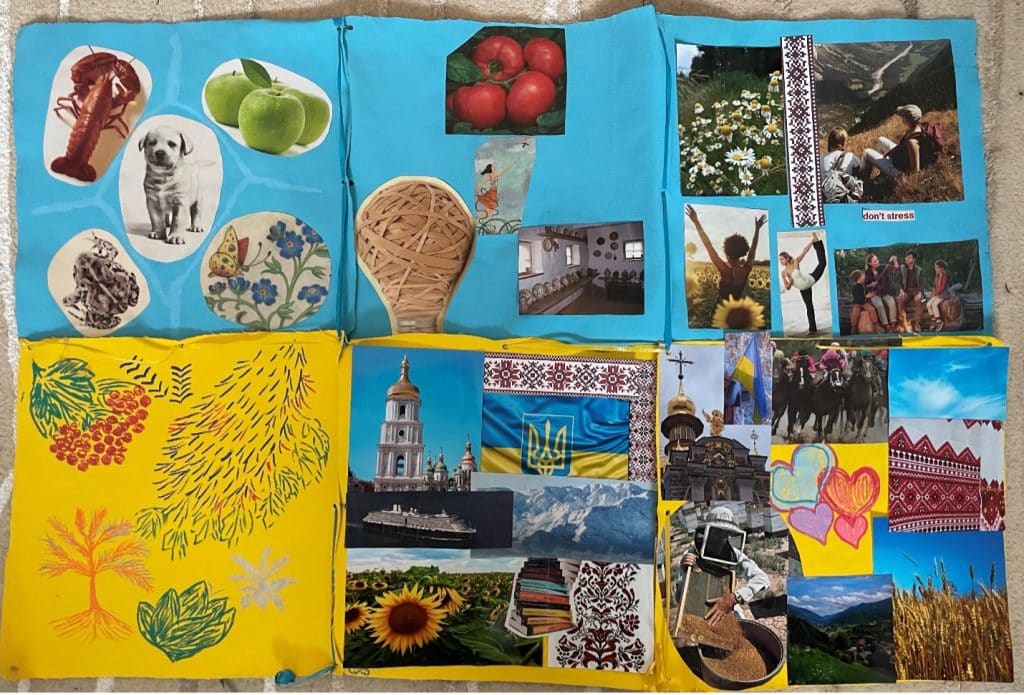
Five Ukrainian refugees consisting of one male and four female participants with a mean age of 36.60 years (SD = 5.86) and who had been in the United States for less than a year took part in the five-session pilot art therapy program led by a licensed art therapist. Present at every session was the primary researcher and one or two interpreters to interpret for the art therapist. The program was held in a community room at a local Ukrainian Church in the Washington DC area and each session was 1-2 hours long. The therapist led participants through a series of collage prompts and discussions about their creations. Due to the short timeframe of the pilot program, the goal was to encourage cultural connection and relieve stress rather than facilitate deep trauma work. No therapy was offered in the first session; participants gave informed consent and were given time to get to know one another and ask questions about the program. In the second and third sessions, participants engaged in collaged art of their safe places and integrations between opposing concepts, such as hope and loss or Ukraine and the US. In the final two sessions, they worked together to create a community flag (see image below) by decorating squares of yellow or blue canvas with representations of what being Ukrainian meant to them, with the final creation being the assembly of all the canvas squares into a Ukrainian flag.
Before and after the program, participants completed surveys assessing their anxiety, resilience, and sense of connection to their local Ukrainian community. We chose to examine these variables for a few reasons. First, we wanted to see if the program might assist in reducing anxiety because refugees experience anxiety at a rate significantly higher than the general population (WHO, 2025). Second, we focused on resilience because it has been found to be a protective factor against trauma and anxiety (Leys et al., 2021). Similarly, we chose connection to a local community of people from their shared culture as our final variable because community has been found to be beneficial to refugees’ mental health (Ermansons et al., 2023).
In addition to completing the pre-post quantitative measures, participants also took part in an interview with the primary researcher during the final session. The interview transcripts were translated from Ukrainian to English and then analyzed using consensual qualitative research (CQR; Hill et al., 1997). CQR analysis was performed by a team of four students, including the primary researcher. All four researchers identified as White, two identified as cisgender women, one identified as genderqueer, and one identified as nonbinary. The auditor, who identified as a White female, is a counseling psychologist with expertise in psychotherapy research and the use of CQR for data analysis. The team analyzed the interview transcripts to uncover core ideas and categories in the following three domains: Art-making experience, benefits of the program, and suggested changes to the program.
The pre-post survey results revealed reduced anxiety levels, increased resilience, and improved community connection. Given the small sample size, caution should be taken when interpreting the success of this program; however, the qualitative data was shown to support the quantitative findings. In every interview, participants expressed they had a positive artmaking experience and drew some type of emotional benefit from the program. Most mentioned that communication with others as an additional benefit with two participants reporting this was the greatest benefit of the program. Despite the positive reactions, all participants felt that the program was too short and reported a desire for both more sessions throughout the program and longer sessions.
Implications for Research and Practice
The greatest takeaway from the pilot study is that culturally informed group art therapy shows potential, but there needs to be more: more research, more sessions, and more participants. Ultimately, this study was an exploratory pilot program; it was by no means conclusive, but the results did show promise. As noted above, refugees struggle with anxiety at a higher rate than the general population (WHO, 2025). Previous research shows promise that art therapy is an effective treatment modality for addressing anxiety with adolescents and adults (Newland & Bettencourt, 2020). In addition, Haiblum-Itskovitch et al. (2018) studied the effects of creating art on both emotional and biological processes such as heart rate. They found that creating art, and particularly with oil pastel, was associated with enhanced mood and physiological arousal; however, not all art forms (e.g., working with pencil) had the same effects. They suggested that fluidity and enhanced tactile experience of working with paints may explain the different physiological and emotional responses. Thus, the link between emotional experiences and art therapy may be a beneficial topic of study with refugee populations, as these studies suggest artmaking could potentially give a space to express and process positive and empowering emotions. Combined with our focus on culturally significant art forms, our findings add to this body of work and future research should continue to build on these findings in a variety of ways. Most notably, researchers should explore reductions in anxiety and increases in community connection in group art therapy for refugees across longer periods of time and with larger sample sizes.
In addition, art therapy practitioners who work with refugees should remain mindful of cultural factors. Attending to culture and community within the therapeutic framework may go a long way in making refugees feel less isolated and more comfortable with receiving support to address some of the unique hardships they may face. As Hanania (2020) found, implementing a culturally focused program helped participants connect to their homeland and to one another. The results of the present study further emphasize the importance of a culturally- and community-focused approach.
Yet mental health support, even when aiming to build resilience and community connections, is not enough on its own to truly support refugees’ well-being. Silove et al. (2017) explain that mental health struggles in refugees are best understood as the result of imbalanced environmental factors rather than innate, pre-determined, and individual ones. Advocating for and implementing more comprehensive and accessible systemic supports (financial aid, transportation, health insurance, etc.) is essential to stabilizing the mental health struggles of this population. Networking with aid organizations to ensure continued physical and mental health support may serve as a beneficial supplement to therapy (see list of organizations below). Overall, refugees continue to face limited and lacking resources across multiple areas, therefore, ensuring this support is accessible, multidimensional, and effective is crucial. It is our hope that the findings of this initial pilot study will help guide researchers and practitioners to consider additional ways to help the ever-growing refugee populations around the world.
Listed below are a few aid organizations for the Ukrainian population with helpful resources:
- United Help Ukraine: https://unitedhelpukraine.org/
- Nova Ukraine: https://novaukraine.org/
- US Ukrainian Activists: https://usukrainianactivists.org/
- Telehelp Ukraine: https://telehelpukraine.com/